EPOWREY Golf Cart Charger — 15 Amp 48 Volt & Battery Models

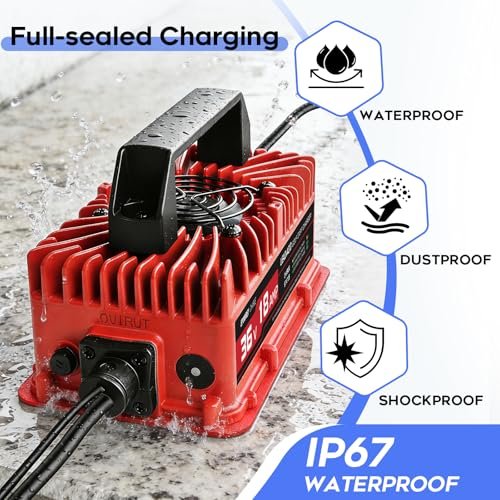
EPOWREY golf cart charger models ship with the exact plug your cart needs — D-style for EZGO TXT, 3-pin round for Club Car DS and Precedent, 3-pin leaf for Yamaha G29, and more — so there's no adapter guessing, no rewiring, no compatibility anxiety. The die-cast aluminum housing and abrasion-resistant rubber cord carry an IP67 dust and waterproof rating, built for the garage floors and outdoor storage conditions where golf cart chargers actually live. When batteries reach capacity, the charger transitions to trickle mode and cuts main charging current automatically — solid green light means you're done. Whether you're running a 36V lead-acid TXT, a 48V Club Car Precedent with a 15 amp 48 volt battery requirement, or a lithium-upgraded cart, there's a purpose-matched EPOWREY model for your setup — find it on the official EPOWREY website.
✓ Model-matched plug✓ IP67 aluminum build✓ Automatic cutoff
View on Amazon
EPOWREY 18 AMP 36 Volt Golf Cart Battery Charger for EZGO TXT with D Style Plug
One Plug Per Cart, No Adapters

EPOWREY ships D-style, 3-pin round, 3-pin triangular, 3-pin leaf, 2-pin, crowfoot, Anderson SB-50, and M8/M25 terminal variants — one connector matched to each cart platform, not a universal unit that requires aftermarket adapters.

IP67 Aluminum Housing and Rubber Cord

Die-cast aluminum alloy construction with an abrasion-resistant rubber cord (not PVC) and a full IP67 dust and waterproof rating — sealed against dust ingress and submersion to 1 meter.

Automatic Cutoff at Full Charge

Every EPOWREY charger transitions to trickle mode when batteries reach capacity and cuts main charging current automatically — solid green light confirms completion, designed for overnight charging without battery-damage risk.

1-Year Warranty, 24-Hour Support Response

All EPOWREY chargers include a 1-year manufacturer warranty with a committed 24-hour response window — a concrete after-sale assurance, not a vague promise buried in fine print.

EPOWREY Golf Cart Charger Lineup by Cart Model

EPOWREY builds a specific charger for each major golf cart platform — 36V and 48V, lead-acid and lithium, portable and onboard — so the right model for your cart comes down to four things: your cart's voltage, plug type, battery chemistry, and whether you need a portable unit or a permanently mounted one. The products below are grouped by voltage and chemistry to make that decision as direct as possible.

EPOWREY 18 AMP 36 Volt Golf Cart Battery Charger for EZGO TXT with D Style Plug

36V EZGO TXT D-Style 18A

The flagship 36V charger in the EPOWREY lineup. The D-style Powerwise plug fits EZGO TXT carts directly, replacing OEM chargers including the Powerwise EZ28115-G04, 28115G01, Sy19300-88, Lestronic II 602718, and Delta-Q 9153610. At 18A output and 5.5 lbs with a 16-foot rubber cord, it's the most-reviewed product in the line at 832 ratings and 4.5 stars.

The only EPOWREY 36V charger purpose-built for EZGO TXT — if you have a D-style Powerwise port and a lead-acid, AGM, or gel battery bank, this is your direct OEM replacement.

See on Amazon
EPOWREY 18 Amp 36 Volt Golf Carts Battery Charger for EZGO & Yamaha with Crowfoot Plug

36V Crowfoot 18A (Multi-Brand)

The broadest-compatibility option in the 36V lead-acid line. The crowfoot plug covers older EZGO, Club Car, and Yamaha models equipped with crowfoot receptacles — three cart brands from a single charger variant. Same 18A output, IP67 rating, 5.5 lbs, and 16-foot rubber cord as the D-style model.

Best choice when you have a crowfoot receptacle and aren't certain which brand originally equipped the cart — or when you need one charger that works across multiple cart brands at 36V.

See on Amazon
EPOWREY 18 AMP Golf Cart Charger 36 Volt Anderson SB-50 Plug for EZGO Marathon-Lead Acid Battery

36V EZGO Marathon Anderson SB-50

Built specifically for EZGO Marathon carts with an Anderson SB-50 connector — a plug no other EPOWREY 36V model covers. CEC and FCC certified (the only 36V model in the line with CEC listed), with a top-mounted cooling fan and explicit trickle charge mode. 18A output at 36V, IP67-rated, 16-foot cord.

EZGO Marathon owners have a specific plug need, and this is the only EPOWREY charger that meets it — don't substitute a crowfoot or D-style unit.

See on Amazon
EPOWREY 15 AMP 48 Volt Golf Carts Battery Charger for Club Car 3-Pin Round Plug

48V Club Car 3-Pin Round 15A

The flagship 48V charger and the most-reviewed 48V product in the EPOWREY line at 825 ratings. The 3-pin round plug fits Club Car DS and Precedent models. Designed to work with functioning OBC systems and non-OBC setups alike — and the listing explicitly notes that buyers with a faulty OBC should consider the onboard bypass models instead. Die-cast aluminum housing, rubber cord, IP67.

Club Car DS and Precedent owners replacing a dead OEM charger — read the OBC note before ordering if you've been having charging issues, because a faulty OBC requires a different solution.

See on Amazon
EPOWREY 15 AMP Golf Cart Charger for 48 Volt EZGO RXV & TXT with 3 Pin Triangular Plug-Lead Acid Battery

48V EZGO RXV/TXT 3-Pin Triangular

The highest-rated charger in the entire EPOWREY lineup at 4.6 stars across 163 reviews. The one-piece 3-pin triangular plug covers both EZGO RXV and TXT in their 48V configurations — two popular EZGO platforms from a single model. DOE and FCC certified. The upgraded one-piece plug design reduces copper core misalignment and improves heat conduction over split-plug alternatives.

If you have a 48V EZGO RXV or TXT and want the highest-rated charger in the EPOWREY line, this is the one — the one-piece plug upgrade is a meaningful build improvement over standard designs.

See on Amazon
EPOWREY 15 Amp 48 Volt Golf Cart Battery Charger for Yamaha G29 with 3-Pin Leaf Plug

48V Yamaha G29/Drive Leaf Plug

Purpose-matched for Yamaha G29, Drive, and Drive 2 carts with the 3-pin leaf plug those platforms use. 15A at 48V with protections against overload, over-voltage, short circuit, and reverse polarity. IP67-rated, 5.5 lbs, 16-foot cord, plug-and-play operation — no settings, no switches.

Yamaha G29, Drive, or Drive 2 owners need the leaf plug specifically — this is the correct model, and the plug-and-play operation makes it a straightforward OEM replacement.

See on Amazon
EPOWREY 15 Amp 48 Volt Golf Cart Battery Charger for Yamaha G19-G22 with 2-Pin Plug

48V Yamaha G19-G22 2-Pin

The only EPOWREY model that covers the legacy Yamaha G19 through G22 platform. The 2-pin plug is specific to these older carts — the leaf-plug G29 model won't fit, and the crowfoot won't either. Same 15A/48V output and IP67 build as the rest of the 48V Yamaha line, with the same 16-foot rubber cord and plug-and-play operation.

Owners of older Yamaha G19, G20, G21, or G22 carts have a legacy plug need that no other EPOWREY model addresses — this is the one.

See on Amazon
EPOWREY 15 AMP Golf Cart Battery Charger for 48 Volt Golf Carts with Universal Fit- Lead Acid Battery

48V Universal M8 Terminals UL

The only 48V lead-acid EPOWREY model with UL listing. Instead of a plug-specific connector, it uses M8 ring terminals that bolt directly to battery terminals — bypassing the cart's receptacle and OBC entirely. A named 3-stage charging algorithm runs Precharge, then Absorption, then Float, with a dedicated Fault indicator light separate from the Power, Charging, and Full indicators. 16-foot cord, IP67.

The right answer when your cart's OBC is dead or your receptacle is damaged — M8 terminals connect directly to the battery bank and charge regardless of the OBC's condition.

See on Amazon
EPOWREY 48 Volt Golf Cart Battery Charger Onboard 15 AMP for EZGO TXT RXV/Club Car/Yamaha with Ring Terminals Plug

48V Onboard M8 Under 40dB (Black)

The quietest charger in the EPOWREY lineup at under 40dB — the only model in the line with a specified noise rating. M8 ring terminals for permanent onboard mounting, 4-indicator system (Power, Charging, Fully Charged, Fault), and a molded carry handle if you need to move it. Universal 48V lead-acid compatibility across EZGO, Club Car, and Yamaha. 5.5 lbs, IP67.

Built for residential areas, clubhouses, or anywhere fan noise is a real concern — sub-40dB operation is a documented spec, not a marketing claim.

See on Amazon
EPOWREY 15 AMP 48 Volt Onboard Golf Cart Battery Charger with Ring Terminals Plug for Lead Acid Battery

48V Onboard M25 Terminals (Silver)

The heavier-terminal sibling to the black M8 onboard model, using M25 ring terminals instead — a larger, corrosion-resistant O-ring connection designed for permanent wiring in the cart. Silver colorway. Universal 48V compatibility across EZGO RXV, TXT, Club Car, and Yamaha. Same 3-stage Precharge/Absorption/Float algorithm, 5.5 lbs, 1-year warranty.

M25 terminals carry more surface area and lower resistance than M8 — the better choice when you're wiring a charger permanently into the cart and want the most secure terminal connection available.

See on Amazon
EPOWREY 18AMP Lithium Golf Cart Battery Charger for 48 Volt/58.4V (51.2V) LiFePO4 Battery for Golf Cart

48V Lithium LiFePO4 18A (Black)

The only 48V lithium charger in the EPOWREY lineup. Outputs 58.4V to charge 16-string LiFePO4 packs (51.2V nominal), with ring terminals for onboard mounting or wall installation. 18A output — 3A more than the lead-acid 48V models. CEC, DOE, and FCC certified. Pre-charge function for deeply discharged cells. Compatible with golf carts, RVs, boats, forklifts, and solar systems. 5.7 lbs.

If you've upgraded your cart to a 48V lithium LiFePO4 pack, this is the only EPOWREY charger that uses the correct charging profile — using a lead-acid charger on lithium cells will damage the pack.

See on Amazon
EPOWREY 25AMP Lithium Golf Cart Battery Charger for 36 Volt/43.8V(38.4V) LiFePO4 Battery for Golf Cart

36V Lithium LiFePO4 25A (Black)

The fastest charger in the entire EPOWREY lineup at 25A — 7A more than the lead-acid 36V models and the highest amperage output across all 12 products. Outputs 43.8V for 12-string LiFePO4 packs (38.4V nominal). Ring terminals, wall-mountable, 5.7 lbs. Holds a perfect 5.0/5 rating across 48 reviews. Pre-charge function, automatic shutoff, over-voltage and reverse polarity protection. Multi-application compatible.

The 36V lithium option for buyers who want the shortest possible charge time — 25A into a 36V LiFePO4 pack is meaningfully faster than any lead-acid charger in the lineup, and the 5.0/5 rating backs it up.

See on Amazon

Which EPOWREY Charger Fits Your Cart

Start with voltage — it's the one variable that cannot be wrong. A 48V charger will not charge a 36V system, and vice versa. Once you've confirmed your cart's voltage, the right EPOWREY model comes down to plug type, battery chemistry, and — for Club Car owners — whether your OBC is functioning. Run through these four questions in order and you'll land on the correct charger without guesswork.

Step 1 — What voltage is your cart?

Check your battery compartment. Count the batteries and their individual voltage: six 6V batteries = 36V total; six 8V batteries = 48V total; four 12V batteries = 48V total. If you're not sure, look up your cart's model year on the manufacturer's site — most EZGO TXT carts built before 1994 are 36V, while post-1994 TXTs and most RXVs run 48V. Yamaha G29 and Drive series are 48V; G19 through G22 are also 48V. Club Car DS and Precedent models sold after 1996 are typically 48V.

Step 2 — What plug receptacle does your cart have?

This is the visual check. Look at the charging port on your cart — the shape of the receptacle tells you exactly which EPOWREY model you need:

  • D-shaped two-pin opening (Powerwise style) — EZGO TXT, 36V. You want the 36V EZGO TXT D-Style 18A (B0CYSW7HB9). This replaces OEM part numbers including EZ28115-G04, 28115G01, and Lestronic II 602718.
  • Round three-pin opening — Club Car DS or Precedent, 48V. That's the 48V Club Car 3-Pin Round 15A (B0CYPVLQRX). Read the OBC note in Step 4 before you order.
  • Triangular three-pin opening — EZGO RXV or TXT on the 48V system. The 48V EZGO RXV/TXT 3-Pin Triangular (B0DR8MP3TR) covers both models and holds the highest rating in the lineup at 4.6 stars across 163 reviews.
  • Leaf-shaped three-pin opening — Yamaha G29, Drive, or Drive 2 (48V). Use the 48V Yamaha G29/Drive Leaf Plug (B0CYSYYL6B).
  • Two-pin opening, older Yamaha — G19, G20, G21, or G22 (48V). The 48V Yamaha G19-G22 2-Pin (B0CYSZW1Q5) is the only EPOWREY model built for this platform.
  • Crowfoot-style receptacle — Found on some older EZGO, Club Car, and Yamaha models. The 36V Crowfoot 18A (Multi-Brand) (B0CYSKW4CX) covers all three brands in one unit.
  • Anderson SB-50 connector — EZGO Marathon specifically. That's the 36V EZGO Marathon Anderson SB-50 (B0DZ2BLYN7), the only EPOWREY model with this plug.
  • No receptacle / wiring directly to battery terminals — You need a ring-terminal charger. See Step 4 and the onboard section below.

Step 3 — What battery chemistry do you have?

Every plug-specific EPOWREY model in the lineup — the D-style, 3-pin round, triangular, leaf, 2-pin, crowfoot, and Anderson SB-50 variants — is designed for lead-acid batteries only. That includes flooded lead-acid, AGM, and gel cell types. None of these chargers will correctly charge a lithium pack.

If you've already upgraded to a LiFePO4 battery system, you need one of the two E10-series lithium models: the 48V Lithium LiFePO4 18A (B0F6MFZLD1) for 48V packs or the 36V Lithium LiFePO4 25A (B0F6MJV9D4) for 36V packs. Both connect via ring terminals directly to the battery bank — there's no plug-specific connector option for lithium, which makes sense since lithium upgrades almost always involve rewiring anyway.

Step 4 — Club Car owners only: check your OBC status

If you have a Club Car DS or Precedent, the OBC (onboard computer) is the variable that most buyers don't think about until their new charger does something unexpected. The 48V Club Car 3-Pin Round 15A is designed to work with a functioning OBC and with non-OBC setups. But if your OBC is faulty — which is common on older Club Cars — the charger may show a flashing yellow light and not complete a full charge cycle through the receptacle.

In that case, the right solution isn't a different plug-style charger — it's bypassing the receptacle entirely and charging directly at the battery terminals. EPOWREY's onboard/ring-terminal models (B0FZFYZNKX, B0FZG7ZNN1, B0FZG2S1KT) handle that exact situation. More detail on the OBC issue is in the dedicated section below.

Quick reference by cart model

Cart Brand / Model Voltage Plug Type EPOWREY Model ASIN
EZGO TXT (36V) 36V D-Style Powerwise 36V EZGO TXT D-Style 18A B0CYSW7HB9
EZGO Marathon 36V Anderson SB-50 36V EZGO Marathon Anderson SB-50 B0DZ2BLYN7
EZGO RXV / TXT (48V) 48V 3-Pin Triangular 48V EZGO RXV/TXT 3-Pin Triangular B0DR8MP3TR
Club Car DS / Precedent 48V 3-Pin Round 48V Club Car 3-Pin Round 15A B0CYPVLQRX
Yamaha G29 / Drive / Drive 2 48V 3-Pin Leaf 48V Yamaha G29/Drive Leaf Plug B0CYSYYL6B
Yamaha G19–G22 48V 2-Pin 48V Yamaha G19-G22 2-Pin B0CYSZW1Q5
EZGO / Club Car / Yamaha (crowfoot port) 36V Crowfoot 36V Crowfoot 18A (Multi-Brand) B0CYSKW4CX
Any 48V lead-acid (terminal mount or faulty OBC) 48V M8 or M25 ring terminals 48V Universal M8 Terminals UL / Onboard models B0FZFYZNKX / B0FZG7ZNN1 / B0FZG2S1KT
Any 48V lithium (LiFePO4) 48V Ring terminals 48V Lithium LiFePO4 18A B0F6MFZLD1
Any 36V lithium (LiFePO4) 36V Ring terminals 36V Lithium LiFePO4 25A B0F6MJV9D4

What EPOWREY Charger Lights Actually Mean

Every EPOWREY charger communicates its status through indicator lights — and knowing what you're looking at prevents 90% of the "is this thing working?" questions that show up in Amazon Q&A and golf cart forums. The short version: blinking means active, solid green means done, yellow or flashing yellow means something needs attention. Here's the full breakdown.

During an active charge cycle

Once you plug in and the charger detects a battery bank, the charging indicator starts blinking. On most EPOWREY models, you'll see a red or green light cycling as the charger pushes current into the pack. This is normal. The fan will also run during this phase — it's part of how the charger manages heat during sustained output. That fan noise is not a malfunction; it's the thermal management system doing its job.

EPOWREY 18 AMP 36 Volt Golf Cart Battery Charger for EZGO TXT with D Style Plug

What you won't see is the charger sitting silent and dark. If there's no indicator activity at all within a minute of plugging in, check the outlet, check the connection at the cart's receptacle, and confirm the battery bank has enough residual voltage to trigger the charge cycle. Deeply discharged packs sometimes need a moment before the charger registers them — or in some cases, a pre-charge function kicks in to bring severely depleted cells up to a threshold voltage before the main charge begins.

When charging is complete

The solid green light is the signal you're waiting for. It means the charger has completed the main charge cycle and transitioned to trickle or float mode — a low-level maintenance current that keeps the battery at full capacity without pushing voltage higher. At this point, the charger is no longer driving 15A or 18A into the pack; it's holding steady at a much lower maintenance rate.

Solid green doesn't mean the charger has switched off entirely. It means the job is done and the batteries are protected. Leaving it plugged in overnight after the green light appears is by design — that's exactly what trickle mode is for.

What a flashing yellow light means

This is the one that generates the most confusion, and it's almost entirely a Club Car issue.

On Club Car DS and Precedent models, the charger doesn't start a cycle by detecting battery voltage alone — it starts when the OBC (onboard computer) sends a signal through the charging receptacle telling the charger it's okay to begin. If that OBC signal doesn't come through correctly, the charger sees an error state and flashes yellow. The charger isn't broken. The OBC is either malfunctioning or there's a communication issue between the OBC and the charger.

Two separate Facebook Golf Carts group threads documented exactly this pattern on 2013 Club Car Precedent models — users assumed the charger was defective, but the underlying issue was OBC communication. One poster noted the cart wouldn't charge correctly "with the OBC hooked up," and the fix was bypassing the receptacle and charging directly at the battery terminals instead.

The fault indicator on the onboard models (B0FZFYZNKX and B0FZG2S1KT) serves a slightly different function — it signals a detected error condition such as reverse polarity, short circuit, or over-voltage at the battery terminals. If you see a fault light on a ring-terminal model, check that the terminals are connected correctly (positive to positive, negative to negative) before assuming anything else is wrong.

Realistic charge times — what to actually expect

A 48V lead-acid pack charged at 15A will take roughly 7–10 hours from a meaningfully discharged state under normal conditions. The 36V models at 18A run a similar timeline — the higher amperage compensates for the lower voltage so total energy delivery is comparable. These are not manufacturer claims; they're what the math produces when you divide a typical golf cart battery bank capacity (roughly 150–200Ah for a 48V system) by the charge rate, accounting for charging efficiency losses.

A few things will push that number higher:

  • Battery age — older packs that have lost capacity take longer to register as "full" because the charger is working against higher internal resistance
  • Deep discharge — a pack that's been sitting dead for weeks will take longer than one that just ran 18 holes
  • Ambient temperature — cold batteries (below 50°F) accept charge more slowly; hot batteries (above 90°F) may trigger thermal protection that temporarily reduces charge rate

And a few things that should not concern you: if the charger reads green after only 2–3 hours on a battery you think should take longer, check whether the pack is actually fully discharged or whether an OBC issue interrupted the cycle before completion. The Reddit thread from r/golfcarts showing a charger reading "full" after 10 minutes on an old bank was almost certainly a combination of both — a weak pack and an OBC not allowing the full cycle to run.

The 36V lithium model at 25A is a different story. That's the fastest charger in the lineup, and on a fresh lithium pack it will complete a cycle significantly faster than any lead-acid model — though actual time depends on battery capacity and state of charge when you plug in.

The OBC Problem and When to Bypass It

The Club Car OBC is responsible for more charger-related confusion than any other single component in this category. Understanding what it does — and what happens when it doesn't — tells you exactly which EPOWREY product applies to your situation and why.

What the OBC actually does

OBC stands for onboard computer, and in Club Car DS and Precedent models, it sits between the charging receptacle and the battery bank. When you plug a charger into a Club Car's receptacle, the charger doesn't automatically start pushing current. Instead, it waits for the OBC to send a signal — essentially a handshake — that tells the charger the system is ready to accept a charge. The charger then starts, the OBC monitors the charging session, and when batteries approach full capacity, the OBC signals the charger to stop.

This design was intended to add a layer of battery protection. And it works fine when the OBC is functioning correctly.

EPOWREY 18 AMP 36 Volt Golf Cart Battery Charger for EZGO TXT with D Style Plug

When the OBC fails

OBCs on older Club Cars fail. It happens. When the OBC is malfunctioning — or when it's been intentionally bypassed during a previous repair — the charger plugged into the receptacle doesn't receive the start signal. So it sits there, flashing yellow, doing nothing. Or it starts briefly and stops after a few minutes, well before the batteries are actually full.

This is not a charger defect. It's the expected behavior of a receptacle-based charger in the absence of a functional OBC signal. Two documented Facebook Golf Carts group threads show this exact pattern on 2013 Precedent models — users returned chargers assuming they were faulty, only to find the issue was the OBC all along.

EPOWREY's 48V Club Car 3-Pin Round 15A (B0CYPVLQRX) is designed to work with both functioning OBC and non-OBC setups, which handles a wide range of situations. But "non-OBC" in that context means a cart where the OBC has already been fully removed or bypassed in wiring — not one where a failing OBC is still partially in the circuit and sending corrupted signals.

The bypass solution

If your Club Car has a faulty OBC that's still physically installed, the cleanest fix from a charging standpoint is to go around the receptacle entirely and charge directly at the battery terminals. That's exactly what EPOWREY's ring-terminal onboard chargers are built for.

Three models in the lineup connect via ring terminals rather than a cart-specific plug:

  • 48V Universal M8 Terminals UL (B0FZFYZNKX) — UL listed; 3-stage named charging (Precharge, Absorption, Float); M8 terminal size; 4-indicator system including a dedicated fault light. Works with any 48V lead-acid bank regardless of cart brand or OBC status. This is the one EPOWREY specifically recommends for buyers dealing with a faulty OBC.
  • 48V Onboard M25 Terminals Silver (B0FZG7ZNN1) — Same 3-stage algorithm; heavier M25 terminals for a lower-resistance connection; designed for permanent mounting inside the cart bay. Compatible with EZGO RXV/TXT, Yamaha, and Club Car 48V systems.
  • 48V Onboard M8 Under 40dB Black (B0FZG2S1KT) — The quietest model in the lineup at under 40dB operation; M8 terminals; 4-indicator system. Good choice for residential charging environments or anyone who finds charger fan noise disruptive.

All three bypass the receptacle entirely. They wire directly to the battery bank — red terminal to the pack's positive post, black to negative — and the OBC becomes completely irrelevant to the charging process. The charger reads battery voltage directly, runs its 3-stage cycle (Precharge → Absorption → Float), and shuts off when done. No OBC handshake required.

How to know which situation you're in

If you've just bought a 48V Club Car 3-Pin Round 15A and the charger flashes yellow immediately after plugging in, give it this simple test: plug the charger into a wall outlet first, before connecting it to the cart. The power indicator should light up. Then connect to the cart receptacle. If the charging indicator doesn't activate within 60–90 seconds, the OBC is likely not sending a valid start signal.

At that point, you have two options: have the OBC diagnosed and repaired by a golf cart technician, or switch to a ring-terminal charger that bypasses it. If the cart is older and you're not planning other electrical work on it, the bypass route is often the simpler long-term fix.

One honest note: the OBC bypass approach works for lead-acid packs but doesn't resolve any underlying electrical issue with the cart itself. If your cart is also showing other symptoms — erratic speed control, warning lights, unusual behavior — the OBC may be affecting more than just charging, and a technician diagnosis is worth considering before deciding the charger is the only problem to solve.

Fleet and Commercial Cart Charging

Managing a fleet of golf carts changes the math on charger selection entirely. A single-cart owner tolerates one annoying failure and replaces a unit. A fleet manager with 20 carts can't afford a 15% failure rate across the season — that's three carts offline, replacement costs stacking up, and staff time spent troubleshooting instead of operating. The specs that matter most shift accordingly.

Why build quality matters more at scale

The two build details that separate reliable fleet chargers from budget replacements are cord construction and housing material. EPOWREY uses rubber cords rather than PVC across the lineup. That distinction is worth understanding concretely: PVC cords become stiff and brittle in cold storage environments and crack under repeated abrasion against concrete garage floors. Rubber cords flex in cold temperatures and handle abrasion without splitting. For a charger that gets plugged and unplugged 300+ times a year across a fleet, that cord is the part most likely to fail first — and rubber gives it significantly more cycles before it does.

The die-cast aluminum alloy housing is the other durability signal. Plastic housings crack under impact from cart bumpers, tool drops, and the general abuse of a maintenance garage. Aluminum doesn't. The IP67 rating — fully sealed against dust ingress and submersion to 1 meter — means a charger left in an outdoor cart shed during a rainstorm doesn't become a write-off.

The case for onboard chargers in fleet environments

For resorts, retirement communities, and commercial properties running 10 or more carts, the onboard ring-terminal models offer a workflow advantage that's hard to ignore. Instead of staff carrying portable chargers to each cart and connecting plugs at the end of every shift, onboard chargers wire permanently into each cart's battery bay. Charging becomes a simple matter of plugging a standard power cord into the cart — no plug-matching, no carrying a 5.5-lb unit across a cart shed, no accidentally plugging the wrong charger into the wrong cart.

EPOWREY 18 AMP 36 Volt Golf Cart Battery Charger for EZGO TXT with D Style Plug

The 48V Onboard M25 Terminals Silver (B0FZG7ZNN1) and 48V Onboard M8 Under 40dB Black (B0FZG2S1KT) are both designed for this permanent-mount application. The M25 terminal model uses heavier-gauge terminals that maintain a lower-resistance connection over time — relevant when you're wiring a charger that will stay connected to a battery bank for years. The under-40dB model makes noise a non-issue in residential communities or clubhouse charging areas where an industrial fan hum at 2am would draw complaints.

Both carry a 4.7-star rating across 36 reviews, which is a small sample — but consistent with what you'd expect from a purpose-built product in a niche application where buyers have specific requirements and tend to leave detailed feedback when things work as specified.

Mixed-voltage fleets

If your fleet includes both 36V and 48V carts — common when a property has older and newer units running simultaneously — you'll need chargers from both voltage families. EPOWREY's 36V models (all running 18A) and 48V lead-acid models (all running 15A) are separate products, not switchable units. That's intentional: a charger that can't be accidentally set to the wrong voltage is a charger that can't accidentally damage a battery bank. For fleet managers ordering in multiples, label each charger with its cart assignment before deployment.

What to ask before buying in multiples

Three things worth confirming before placing a multi-unit order:

  • Confirm every cart's plug type before ordering. A fleet that looks uniform often isn't — older carts may have been retrofitted with different receptacles or battery banks during previous service. Pull a physical sample from each cart model before ordering 10 of the same charger.
  • Check OBC status on any Club Car in the fleet. If even one Club Car has a faulty OBC, order the ring-terminal bypass model for that unit rather than a standard receptacle charger. Returning a charger from a fleet order is more friction than specifying correctly the first time.
  • Factor in the 1-year warranty and 24-hour support window. For fleet operators, knowing that a support question gets a response within 24 hours matters more than it does for a single-cart owner who can wait a few days. That response commitment applies across all EPOWREY models.

Safety Certifications Across the Lineup

Golf cart charger forums and Amazon review sections contain a recurring skepticism about "Amazon chargers" — the concern that any charger bought online without a recognized brand name is probably a commodity unit with no real safety engineering behind it. That skepticism is reasonable. It's also why third-party certifications exist, and why the specific certifications on EPOWREY's models are worth understanding rather than just listing.

What the certifications actually mean

Four certification bodies appear across the EPOWREY lineup — FCC, CEC, DOE, and UL. They test different things:

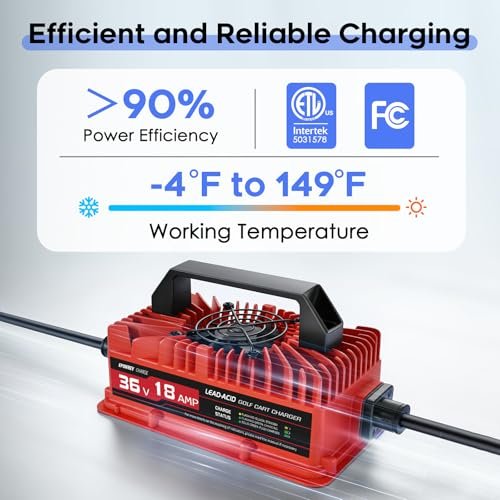
  • FCC covers electromagnetic interference. A charger with FCC certification has been tested to confirm it doesn't emit radio frequency interference that disrupts other electronics nearby. For practical purposes, this matters if you're charging in a garage where your car's key fob or a garage door opener might otherwise get interference from a non-compliant charger. The EZGO RXV/TXT triangular model (B0DR8MP3TR) and the Anderson SB-50 model (B0DZ2BLYN7) both carry FCC certification.
  • CEC (California Energy Commission) is an efficiency standard — specifically for chargers sold in California, where there are mandatory minimum efficiency thresholds for battery chargers. Meeting CEC requirements means the charger converts AC input to DC output at a documented efficiency level. The Anderson SB-50 model (B0DZ2BLYN7) and both lithium models (B0F6MFZLD1 and B0F6MJV9D4) are CEC certified. The 48V lithium model also carries DOE certification — the federal Department of Energy's parallel efficiency standard.
  • UL listing is the most recognized safety certification in the US market. A UL-listed product has been independently tested against established safety standards by Underwriters Laboratories, covering electrical insulation, overheating risk, shock hazard, and construction quality. Among the lead-acid models, only the 48V Universal M8 Terminals UL (B0FZFYZNKX) carries UL listing — making it the standout option for buyers where institutional or insurance requirements mandate a UL-listed charger. Fleet operators charging in commercial environments or HOA facilities sometimes encounter this requirement.

Built-in protection features across the lineup

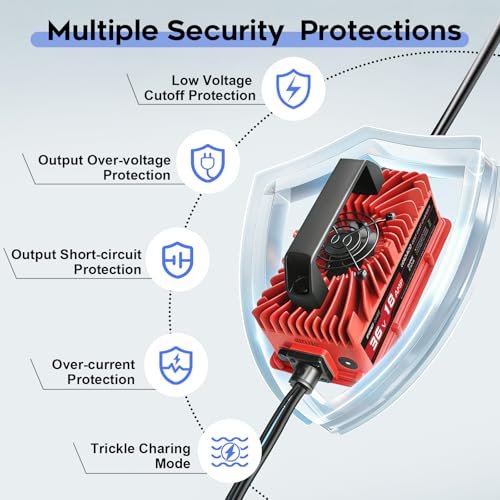
Certifications are one layer. The onboard protection circuits are another, and they're what actually intervene during a charging session if something goes wrong. All EPOWREY models incorporate multiple protection modes — here's what each one does in plain terms:

  • Over-voltage protection cuts power if the output voltage rises above the rated level, preventing damage to battery cells from excess voltage during the charge cycle
  • Over-current protection limits current if the draw exceeds the charger's rated amperage — relevant if there's a short in the battery wiring or a cell failure mid-charge
  • Over-heat protection reduces charge rate or shuts down if the charger's internal temperature exceeds safe operating limits; this is why the cooling fan matters and why a charger placed in an enclosed space with no airflow will trigger this protection before a charger placed in open air does
  • Short-circuit protection detects a dead short at the output terminals and halts operation immediately before current can build to damaging levels
  • Reverse polarity protection — present on the crowfoot, Yamaha leaf, Yamaha 2-pin, Anderson SB-50, and ring-terminal models — prevents damage if the terminals are connected backwards. On ring-terminal models where you're physically attaching cables to battery posts, this is the protection feature most likely to save you from a wiring mistake during installation.

The pre-charge function on both lithium models (B0F6MFZLD1 and B0F6MJV9D4) and the Anderson SB-50 model (B0DZ2BLYN7) deserves specific mention. Pre-charge brings severely depleted cells up to a threshold voltage using a reduced current before transitioning to the main charge cycle. Forcing a full charge rate into a deeply discharged lithium pack can stress or damage cells; the pre-charge stage prevents that. It also explains why a nearly-dead pack may take longer to start showing active charging indicators — the charger is doing protective work before the main cycle begins.

Who this matters most for

Honestly, most single-cart owners will never think about any of this — they plug in, see the green light eventually, and move on. But if you're managing a fleet where a charger failure strands a cart mid-shift, or you're operating in a facility with safety compliance requirements, knowing the certification status of each model before ordering is worth the two minutes it takes to check. The UL listing on the M8 Universal model and the CEC/DOE coverage on the lithium models are the specifics most likely to matter for institutional buyers.

For everyone else: the protection features mean that plugging in incorrectly — reversed terminals, wrong voltage accidentally applied, a charger left in a rain puddle — is far less likely to result in a destroyed battery bank than it would be with an uncertified commodity unit. That's not a guarantee, but it's a meaningful difference from the $30 chargers that show up in Amazon searches with no certification information at all.

See the 48V Club Car Charger in Action

We picked this walkthrough because it shows the EPOWREY 48V 15A charger on an actual Club Car with a 3-pin round port — the exact setup where compatibility questions come up most. You'll see how the connector seats, how the indicator lights behave during a real charge cycle, and whether the unit does what we say it does. Watch this before you buy if you want confirmation beyond the spec sheet.

Which EPOWREY Charger Fits Your Cart Model

The four most-reviewed EPOWREY models cover the two most common voltage families and three different connector types. Use this table to confirm the right unit before you buy — voltage and plug type are both non-negotiable, and getting either wrong means returning the charger.

Feature 36V EZGO TXT D-Style 18A 36V Crowfoot 18A (Multi-Brand) 36V EZGO Marathon Anderson SB-50 48V Club Car 3-Pin Round 15A
Voltage 36V 36V 36V 48V
Amperage 18A 18A 18A 15A
Plug Type D-Style (Powerwise) Crowfoot Anderson SB-50 3-Pin Round
Compatible Carts EZGO TXT EZGO, Club Car, Yamaha (crowfoot models) EZGO Marathon Club Car DS, Precedent
Battery Chemistry Lead-acid, AGM, Gel Lead-acid Lead-acid Lead-acid
OBC Support N/A (EZGO) N/A N/A Yes — OBC and non-OBC
Certifications IP67 IP67 CEC, FCC, IP67 IP67
Weight 5.5 lbs 5.5 lbs Not specified 5.5 lbs
Cord Length 16 ft 16 ft 16 ft 16 ft

EZGO TXT owners on 36V should go straight to the D-Style model — it directly replaces the Powerwise EZ28115-G04 and equivalents without any adapter. Club Car DS or Precedent owners on 48V need the 3-Pin Round model, and should read the OBC section of this page before buying if they're unsure whether their onboard computer is functioning. The Crowfoot and Anderson SB-50 models cover specific connector types that the other two don't — if you're not sure which plug your cart has, check the receptacle on the cart itself before ordering.

Real Buyers on EPOWREY Chargers After Daily Use

"My OEM Powerwise charger finally quit after 11 years, and I needed something that would fit the D-style port on my EZGO TXT without any adapters. This one plugged right in, the indicator light went through its cycle, and it was showing solid green by morning. Exactly what I needed — no surprises."
— Gary M., retired homeowner replacing a dead OEM charger
"I manage 14 carts at our community and bought three of these for the Club Car Precedents. Two years in, all three are still running. The rubber cord holds up a lot better than the cheaper PVC-cord units I bought previously — those started cracking at the strain relief within a season. The OBC situation took a little reading to understand, but once I did, no issues."
— Dennis R., fleet coordinator at a retirement community
"I've got a modified 48V Club Car with the OBC bypassed. The 3-Pin Round charger didn't work for me until I realized it was trying to communicate with an OBC that wasn't there anymore. Switched to the onboard bypass model and it's been flawless. Appreciated that EPOWREY actually explains this situation in their listing instead of hiding it."
— Kyle B., DIY cart builder and modifier
"Bought this for my Yamaha G29 after the original charger died. Plugged the 3-pin leaf connector in, fan ran, lights did their thing, and it was done by 6am. Simple as it should be. The 16-foot cord is genuinely useful — my garage outlet isn't anywhere near where the cart parks."
— Carol T., neighborhood cart owner using her G29 for community errands
"The charger works well but I'll be honest — the fan noise caught me off guard the first time. I thought something was wrong. Would have helped to know upfront that the cooling fan running during the charge cycle is normal and expected. Once I figured that out, no complaints. Solid green light, batteries read full in the morning."
— Frank H., casual golf cart owner, recent used-cart buyer
"Used to have one of those no-name 36V chargers that would read 'full' in about 12 minutes — which, if you know anything about lead-acid, is not how that works. The EPOWREY actually runs a real charge cycle, 8 hours on a bank that was well depleted. Indicator light behavior makes sense once you watch it a couple of times. Definitely not a fake-out charger."
— Andrew P., forum regular on r/golfcarts and longtime DIY cart enthusiast

Golf Cart Charger Questions Answered

Are golf cart battery chargers universal?

No — golf cart chargers must match on three variables: voltage (36V or 48V), plug type (D-style, 3-pin round, crowfoot, and others), and battery chemistry (lead-acid vs. lithium). A 48V charger won't charge a 36V system, and the wrong plug simply won't connect. EPOWREY builds one charger per connector type to eliminate adapter guesswork.

What amp charger do I need for a 48 volt golf cart?

15A is the standard output for 48V lead-acid golf cart chargers, and that's what EPOWREY's 48V lead-acid models deliver. Amperage determines charge speed — 15A at 48V puts roughly 720 watts into the battery bank, producing a full charge cycle in approximately 7–10 hours under normal conditions. The EPOWREY 48V lithium model runs at 18A for a faster cycle on LiFePO4 packs.

Can you leave a golf cart battery charger on all night?

Yes, if the charger has a proper automatic shutoff — and EPOWREY chargers do. When the battery bank reaches full charge, the charger transitions to a low-current float (trickle) mode rather than continuing to push full amperage. The solid green indicator light confirms this transition has occurred. Leaving it connected overnight is the intended use case, not a risk.

Why does my EPOWREY charger flash yellow?

A flashing yellow light on a Club Car model almost always indicates an OBC (onboard computer) communication issue — not a charger defect. The OBC on Club Car DS and Precedent models signals the charger through the receptacle, and if that signal is absent or garbled (often due to a failing OBC), the charger can't initiate or complete a charge cycle. The EPOWREY onboard bypass models connect directly to the batteries and resolve this issue entirely.

How long does it take to charge a 36 volt EZGO golf cart?

With the EPOWREY 36V/18A D-Style charger, a well-depleted EZGO TXT battery bank typically takes 7–10 hours to reach full charge. Actual time depends on battery capacity, how deeply discharged the pack is, battery age, and ambient temperature. A battery bank that's been sitting partially discharged for several days will take longer than one depleted from a single day's use.

How do I tell if my golf cart battery charger is working?

Watch the indicator light sequence. During active charging, the light blinks or shows red/amber — this is normal. When the charger transitions to float mode and the cycle is essentially complete, the light turns solid green. If you see a flashing yellow on a Club Car, that signals an OBC communication problem rather than a charger failure. No light at all after plugging in usually points to a connection or receptacle issue.

Does the EPOWREY charger work with lithium batteries?

The plug-specific EPOWREY models — D-style, 3-pin round, crowfoot, leaf plug, and others — are designed for lead-acid, AGM, and gel batteries only. Using a lead-acid charger profile on a lithium pack can damage the cells. For LiFePO4 battery upgrades, EPOWREY makes dedicated lithium models: the E10-48V18A for 48V packs and the E10-36V25A for 36V packs — both use ring terminals and a lithium-specific charging algorithm.

What's the difference between the EPOWREY onboard and portable chargers?

The portable models (D-style, 3-pin round, crowfoot, and other plug-specific units) come with a 16-foot cord and connect through the cart's existing charging receptacle. The onboard models (M8 and M25 terminal variants) wire directly to the battery terminals for permanent mounting inside the cart — useful for carts with dead OBC systems or non-standard receptacles. Both charge at 48V/15A, but the onboard models bypass the receptacle entirely.

Can I charge my 36 volt golf cart with a regular car battery charger?

No. A standard 12V automotive charger cannot charge a 36V golf cart battery bank correctly — the voltage mismatch means it either won't initiate a charge or will deliver incorrect current to the pack. A 36V golf cart requires a charger specifically rated for 36V output. Using the wrong voltage charger risks battery damage and won't register a full charge regardless of how long it runs.

How do I know if my golf cart charger is bad versus the batteries?

Connect a voltmeter to the battery pack before and after a charge attempt. If the charger runs a full cycle (blinking light → solid green) but pack voltage doesn't rise above its discharged level, suspect the batteries — especially if they're more than 4–5 years old. If the charger shows no indicator activity after a confirmed good connection, or immediately flashes yellow without initiating, the charger itself warrants investigation.

Why EPOWREY Built a Charger for Every Cart

The golf cart charger market has a problem that most buyers discover too late: "universal" chargers aren't really universal. They require adapters, communicate poorly with OBC systems, or deliver output profiles that don't match the battery chemistry in the cart. EPOWREY's response to that problem was methodical rather than clever — build one charger per platform, with the correct plug, matched voltage, and a charge algorithm suited to lead-acid or lithium chemistry. Not a product that works on most carts with some fiddling. One that connects directly and completes a real charge cycle.

The lineup reflects that thinking across two voltage families, two battery chemistries, and seven distinct connector types. The 36V and 48V lead-acid models cover EZGO TXT, EZGO RXV, EZGO Marathon, Club Car DS, Club Car Precedent, Yamaha G29, Yamaha Drive, Yamaha Drive 2, and older Yamaha G19 through G22 platforms — each with its own plug, not a shared adapter. The lithium E10 models came later, as LiFePO4 upgrades became common enough that lead-acid charger recommendations were actively harming buyers who'd switched chemistry without switching chargers.

The onboard models — the M8 and M25 terminal variants — exist because of a specific failure mode that shows up consistently in forum discussions and support tickets: Club Car owners with a malfunctioning OBC who can't get a receptacle-based charger to complete a cycle no matter what they try. Rather than leaving those buyers to figure out a workaround themselves, EPOWREY added direct-to-battery onboard chargers to the line. It's not a glamorous product decision. But it's the right one for a buyer who's exhausted their other options at 10pm with a cart that won't charge.

Useful Guides

Derek here—these guides answer the exact questions that come up when your charger arrives or your batteries aren't holding charge like they used to.

About EPOWREY

EPOWREY is manufactured by Shenzhen Yileide Technology Co., Ltd. The brand builds plug-specific golf cart chargers for EZGO, Club Car, and Yamaha platforms, spanning 36V and 48V systems in both lead-acid and lithium LiFePO4 configurations. All products are sold through the official EPOWREY Store on Amazon.com.

Customer Support

EPOWREY commits to responding to all product questions within 24 hours. For support on a specific charger — indicator light behavior, compatibility questions, or warranty claims — contact EPOWREY directly through their Amazon store page. That's the fastest route to a response from the product team.

Warranty and Purchasing

All EPOWREY chargers carry a 1-year manufacturer warranty. Products are available exclusively through Amazon, where current pricing and availability are listed. The EPOWREY lithium models also carry a 7-year EU spare part availability commitment — relevant for buyers who want long-term serviceability on higher-investment chargers.